Today’s warehouses, plants, and carriers are expected to deliver same-day fulfillment, error-free picking, always-on connectivity across sprawling facilities and fleets, and real-time inventory accuracy that holds up across every location. When those systems don’t work together, orders slip, equipment sits idle, and a single delay ripples across the entire supply chain.
Operators are investing in connected supply chain ecosystems—not isolated point products. ScanSource helps partners design solutions that reduce friction at the point of work, integrate with the WMS, TMS, and network infrastructure already in place, and open new recurring-revenue opportunities across the operational lifecycle.
The connected supply chain is a growing opportunity
- RFID raises inventory accuracy from 63% to 95% and cuts retail out-of-stocks by up to 50%. (Auburn University RFID Lab and GS1 US, “Project Zipper”)
- 70% of warehouse decision-makers face pressure to modernize; 64% will raise spending over five years. (Zebra Technologies Warehousing Vision Study, 2025)
- The warehouse automation market will grow from $27.4B in 2026 to $59.5B by 2030, an 18.7% CAGR. (Grand View Research, Warehouse Automation Market Report)
- A single WMTL engagement now spans mobility, barcode and RFID, robotics, wireless networking, video and physical security, power, and operational analytics
Partners who lead with hardware get squeezed on price. Partners who lead with an integrated operations strategy own the relationship.
See how convergence works inside the operation

CONVERGENCE IN ACTION — RECEIVING AND INVENTORY
From dock to shelf without a gap.
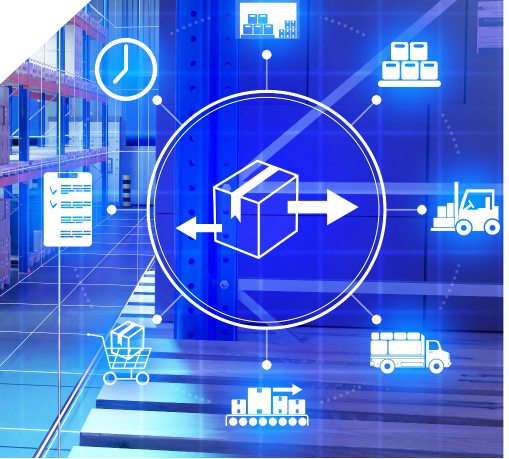
A pallet arrives, is scanned at the door, and every carton on it is reconciled against the ASN before the truck pulls away. RFID confirms what barcodes can’t see, and the WMS updates in real time.
No blind receipts. No cycle-count surprises three weeks later.
Behind that outcome: RTLS and IoT fleet tracking, vehicle-mounted computing, mobile printing, and cloud-connected transportation systems integrated from day one.
CONVERGENCE IN ACTION — PRODUCTION AND FULFILLMENT
More throughput without more headcount.
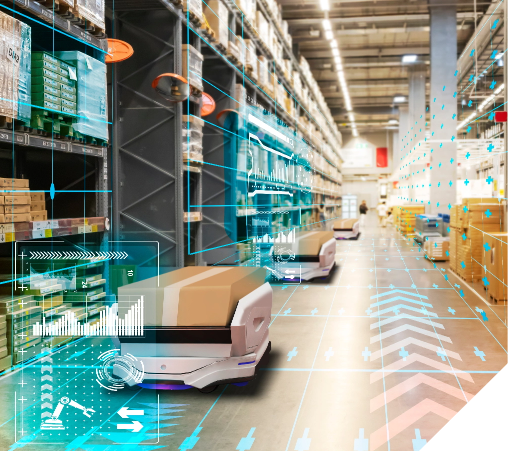
A picker works a wearable scanner while autonomous mobile robots stage the next wave, and machine vision flags a mislabeled case before it leaves the line.
Orders move faster. Rework drops. Labor shifts to the tasks that actually need judgment.
Behind that outcome: AMRs and collaborative robotics, wearable scanning, machine vision, and resilient network infrastructure operating as one.

CONVERGENCE IN ACTION — TRANSPORTATION AND FINAL MILE
Real-time decisions, not end-of-day reports
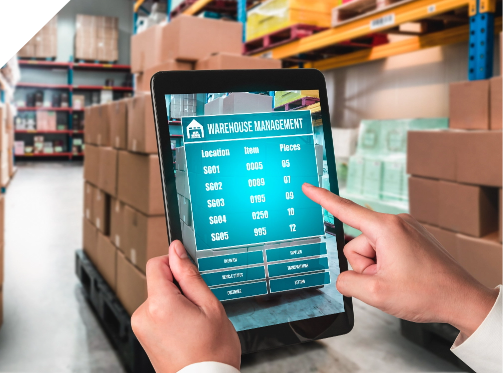
Dispatch sees live load status, vehicle location, and dock congestion from one dashboard—and reroutes before a driver burns an hour waiting.
Operations leaders see the same picture across every facility.
Behind that outcome: RTLS and IoT fleet tracking, vehicle-mounted computing, mobile printing, and cloud-connected transportation systems integrated from day one.
What we support across warehousing, manufacturing, and T&L environments
Every deployment is different. A high-velocity e-commerce fulfillment center doesn’t run like a discrete manufacturing plant, and a cold-storage DC doesn’t run like a carrier’s cross-dock. We help partners understand those differences before they’re in front of the customer.
- Barcode scanning, RFID, and vision-based data capture—accurate data from the receiving dock to the final mile
- Rugged mobility, wearables, and vehicle-mounted computing—devices built for the environments they actually live in
- AMRs, collaborative robotics, and automated sorting—throughput gains without proportional headcount
- Industrial wireless, private 5G, and SD-WANt—the foundation every other system runs on
- RTLS and IoT for asset, inventory, and fleet tracking—visibility across facilities and between them
- Video surveillance, access control, and power protection—protecting people, product, and uptime
- Labeling, mobile printing, and media—compliance and traceability at every handoff
- Operational analytics and cloud-connected WMS and TMS platforms—compliance and traceability at every handoff
What’s next in warehousing, manufacturing, and T&L technology
AI, robotics, and edge computing are reshaping what partners need to scope today—and what they’ll need to lead tomorrow.

Edge intelligence
for real-time operational decisions made where the data is captured

AI-driven demand
forecasting and predictive maintenance that prevents downtime instead of reacting to it

Expanded RFID
adoption for item-level, end-to-end traceability

Private 5G and advanced wireless
built for large facilities, yards, and fleet environments

Vision systems and AI-powered
quality assurance on the line
We’re already helping partners scope for what’s coming—so they’re positioned to lead it, not catch up to it.
Why partners choose ScanSource for warehousing, manufacturing, and T&L
Most partners win in this space by moving from product conversations to platform conversations—and from one-time hardware refreshes to multi-year operational transformation programs.
ScanSource brings together:
- Supplier access—across mobility, barcode, RFID, automation, networking, security, and power
- Solution design support—through our Integrated Solutions
- Staging, kitting, and configuration services—so sites and fleets roll out faster
- Financing options—for multi-site deployments and equipment refresh cycles
- Lifecycle support—to extend value long after the install team leaves
We support the full deployment—not just the product side. From staging through post-deployment, we help you deliver a complete customer experience and build the practice around it.
For more information, check out these deliverables



Featured Products


-
What technology is required to build a connected warehouse, plant, or fleet operation?
A connected operation requires integrated data capture, mobility, automation, networking, security, and analytics platforms that work together in real time to support throughput, inventory accuracy, and uptime across facilities and in transit.
-
How do partners expand into warehousing, manufacturing, and T&L solutions?
By leading with outcomes—throughput, order accuracy, uptime, and labor efficiency—rather than individual products. ScanSource provides solution-design support and supplier access so partners can build complete, multi-vendor solutions that integrate with the systems already running the operation.
-
Can existing infrastructure be upgraded instead of replaced?
Yes. Most WMTL projects extend what's already on the floor. The focus is on integration—connecting legacy WMS, networking, and data capture systems into a unified platform that supports new capabilities like robotics, RFID, and predictive analytics.
-
How does ScanSource support partners through a multi-site WMTL deployment?
From pre-sales design through post-install lifecycle support. Our Integrated Solutions Group helps partners scope, stage, and configure complex multi-vendor environments at scale—so kits arrive on-site ready to deploy, facility by facility, without surprises.