
The 99% advantage: why the best school safety systems are the ones districts use every day
There's a moment that happens in a well-built school safety deployment, usually about 18 months in. A teacher presses the button during a medical emergency. The alert routes to dispatch. The camera covering that hallway surfaces automatically. Doors behave the way the drill said they would. Afterward, when someone asks why it worked, the answer isn't the panic button. It's that every piece in that chain had been in use that morning, and the morning before, for reasons that had nothing to do with an emergency.
That's the gap worth talking about in 2026. The compliance conversation is largely settled; the capability conversation is where the value is now.
The mandates are the starting line
Depending on how trackers classify functionally equivalent legislation, some version of Alyssa's Law has been enacted in as many as sixteen states, with Illinois joining most recently and Mississippi, Michigan, and South Carolina pending. Counts vary—some trackers put it closer to a dozen—but the direction isn't in dispute.
What's expanded fastest is the definition of compliance itself. The 2019 version was straightforward: give staff a silent way to summon law enforcement. The 2026 version assumes an interconnected response—alerts routing directly to the PSAP, staff triggering from anywhere on campus, camera views surfacing for responders, access control executing a lockdown, and mass notification firing across speakers, signage, and devices at once.
And in Florida, there's a provision worth sitting with: if the system fails to connect to the PSAP, the school safety specialist must notify the superintendent, the vendor, and the state's Office of Safe Schools within 24 hours.
Read that as an infrastructure standard. Compliance isn't an event at installation; it's a condition that holds every day, including the days when the power flickers. That's a higher bar, and a better one—it rewards districts that build for continuous availability rather than for inspection day.
What does this system do the other 99% of days?
Emergency technology gets funded on the strength of the worst day and proven on the ordinary ones. Systems carrying daily load are exercised constantly, so anything degraded surfaces within hours instead of at the next drill. Staff are fluent in them. And they're easier to defend at budget time, because the return is visible rather than hypothetical.
That's the design principle worth advocating for: the safety stack and the operations stack should be the same stack. Not two parallel investments, but one integrated infrastructure with two modes.
Entry and identity. The front entrance is the most-used security control on any campus, and it's used for mundane reasons—a parent dropping off a forgotten lunch, a contractor arriving for a repair. Aiphone intercom and entry systems earn their keep hundreds of times a week. The emergency capability isn't a separate feature; it's the same two-way audio link, used under pressure, by staff who already know how it works. Entrust credentialing sits behind that: IDs and mobile credentials are daily tools for access, attendance, and check-in, and also the answer to the question every responder asks—who is supposed to be in this building right now?
Detection and response. An alert that reaches a dispatcher is necessary. An alert that also changes the state of the building is what the newer mandates reach toward. Radionix is the portfolio that turns notification into action—worth stating cleanly, since integrators are still sorting out the structure: Bosch Security Systems now sits under the Keenfinity Group, with Radionix carrying intrusion and access, including the B and G Series panels, alongside Bosch-branded detectors, while video moved to IQSIGHT. Doors lock, zones isolate, alarm management follows a defined sequence. On a normal Tuesday, that same platform handles after-hours arming, athletic facility access, and the false-alarm reduction that keeps law enforcement responsive when something real happens.
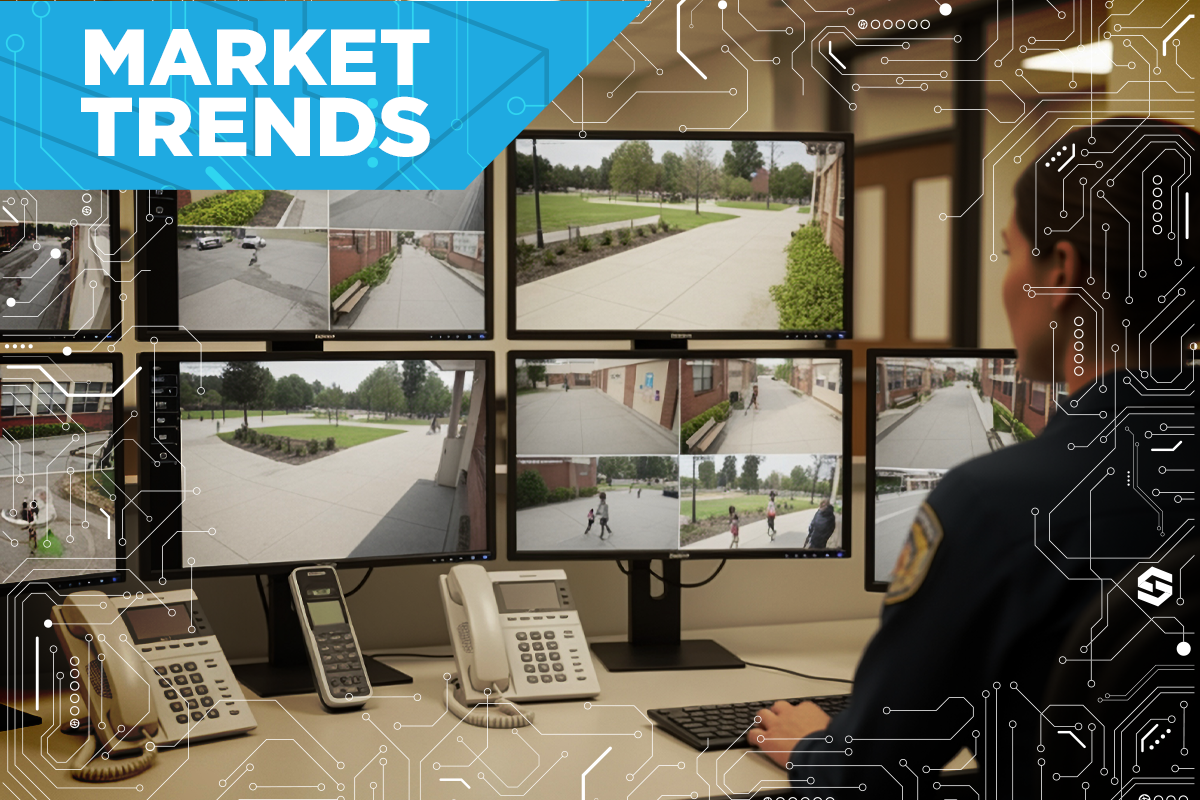
Hanwha Vision cameras earn their keep long before an emergency. Districts use video far more often to resolve a bus loop dispute or a vandalism claim than they ever will for an active threat—and that daily utility is what keeps coverage well-positioned and trusted, so the feed works when responders need it.
The layer that makes compliance hold. Most school network closets were built for a different job: a couple of switches, a server, a phone system. They now carry alert routing, camera traffic, access control, and increasingly some edge compute. CyberPower UPS and power management, and Ditek surge protection on network and low-voltage runs, convert a system that passed inspection into a system that holds. If Florida's 24-hour rule previews where other states are headed, power protection moves from accessory conversation to compliance conversation—worth raising while it's a planning advantage rather than a remediation project.
The same network, five days a week
The strongest argument for treating this as one infrastructure is that districts already run it that way.
The network carrying camera traffic and alert routing is the network carrying instruction. Logitech video collaboration and Jabra audio endpoints are in daily service for what schools now consider baseline: remote speech and occupational therapy, counselors covering multiple buildings, family conferences that actually get attended, credit recovery, and coverage for hard-to-staff courses.
Those deployments justify network investment, PoE capacity, and closet build-out on purely instructional grounds. The safety systems then ride infrastructure that's already funded, monitored, and exercised every school day. That's not a coincidence to be tolerated. It's the argument.
The funding picture just got more interesting
The good news first. The FCC set the FY2026 E-Rate cap at $5.2 billion and in May directed USAC to fully fund every eligible Category One and Two request, with demand around $3.5 billion against the cap. For network and internal connections, this is about as favorable a year as districts have had.
Eligibility still excludes cameras and standalone security software, so most of a physical security project sits outside the program even as the network carrying it sits inside. Separately, the $200 million Cybersecurity Pilot had committed roughly $102 million across six waves as of mid-2026, testing whether cybersecurity becomes a permanent fundable category.
Then, on June 25, the FCC adopted a Notice of Proposed Rulemaking proposing to narrow the scope of eligible services and asking whether the program should be reoriented now that near-universal connectivity is achieved. It published August 14, so the comment window is open as districts plan this year.
Nothing here is law, and practitioners broadly expect a narrower program rather than elimination. The planning guidance is simple, and it's this piece's argument: assume E-Rate continues, but don't assume any single category stays eligible forever. Infrastructure that carries instruction every day has the most funding paths available and the least exposure to any one of them changing.
Questions worth asking a district
- When the panic alert triggers, what else changes state—doors, cameras, speakers, signage, or just a notification?
- Who is notified when a component goes offline, and how quickly?
- What's on battery backup and surge protection in the closet running your safety systems?
- How often has this system been used in the last twelve months? Frequent use is a health indicator; no activation history means the system hasn't been proven, just quiet.
- Which line items belong to which funding stream—and what happens if one changes?
The point
A panic button is a requirement. A response is a system. The districts getting this right aren't spending the most; their safety infrastructure is load-bearing on ordinary days—visible, used, exercised, maintained. That's what turns the extraordinary day into a mode change rather than a first attempt.
Build for the 99%. That's what makes a district ready for the 1%.
Want to look closer at solutions in this industry? Visit the ScanSource page for Education today.